
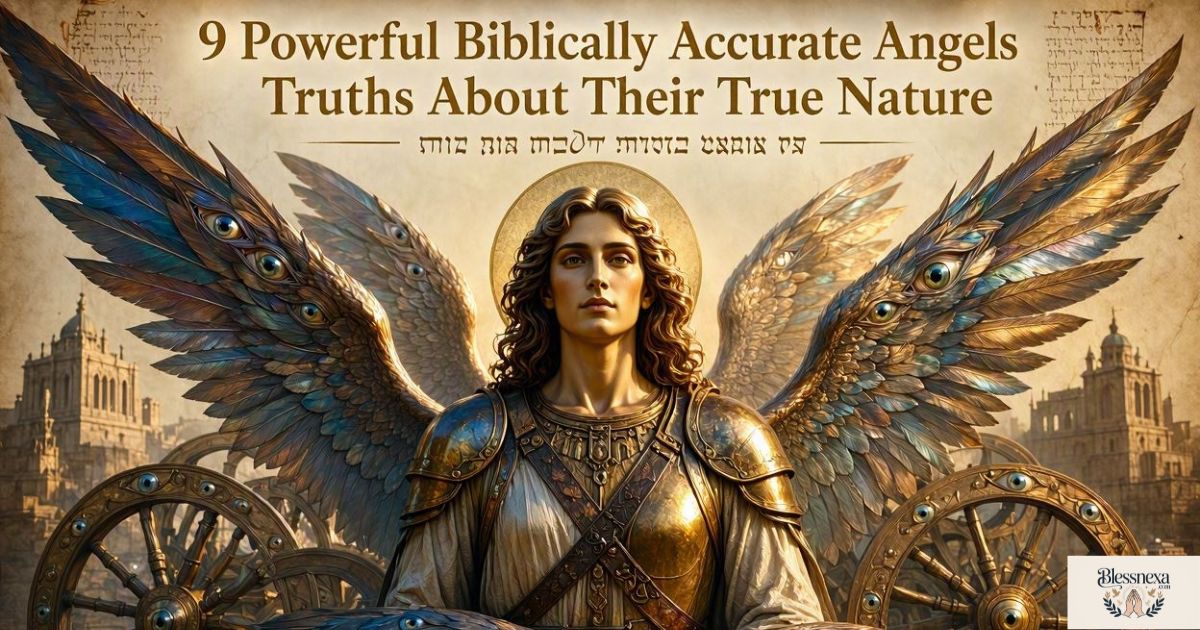
When people imagine angels, they often picture beautiful humans with white robes, glowing halos, and two soft wings. However, the Bible presents a much broader and more mysterious picture. Some heavenly beings appear human, while others are described with multiple wings, faces, eyes, or unusual forms. That is why understanding biblically accurate angels requires looking carefully at Scripture instead of relying on paintings, movies, or popularbiblically accurate angels
The Bible does not give one single appearance for every angelic being. Instead, different passages describe different heavenly creatures and their responsibilities. Some deliver messages. Others worship God, protect sacred places, execute judgment, or participate in spiritual w biblically accurate angels
This article explores those descriptions in a clear and balanced way. It separates biblical teaching from later traditions and explains what Scripture actually says about angels, cherubim, seraphim, archangels, living creatures, and fallen spiritual beings.
1. The Bible Gives a Much Bigger Picture of Angels
- The English word angel comes through Greek angelos, meaning messenger. The Hebrew term malakh also carries the basic meaning of messenger or biblically accurate angels
- Therefore, the word itself primarily describes a role rather than a physical biblically accurate angels
- Scripture uses angelic beings in many different situations. They appear as messengers, servants, biblically accurate angelswarriors, and agents carrying out God’s biblically accurate angels
- This is one reason there is no single universal appearance that can represent every angel in S biblically accurate angels
- When people search for biblically accurate angels, they should first ask what particular biblical being they are biblically accurate angels
- A messenger angel in one passage should not automatically be assumed to look exactly like a cherub or s biblically accurate angels
- Scripture also distinguishes heavenly beings according to their descriptions and f biblically accurate angels
- Hebrews 1:14 describes angels as ministering spirits sent to serve those who will inher biblically accurate angels
- Psalm 103:20 presents angels as powerful beings who obey God’s biblically accurate angels
- Psalm 104:4 connects God’s servants with winds and flames, although the passage has been interpreted in different ways.
- The Bible therefore emphasizes their service to God more strongly than it gives a complete visual catalog of every heavenly biblically accurate angels
- Their purpose matters more than artistic biblically accurate angels
- This biblical approach prevents modern images from becoming substitutes for biblically accurate angels
2. What Do Biblically Accurate Angels Actually Look Like?
- Ordinary angels in the Bible are not always described in biblically accurate angels
- In several passages, angels appear in a recognizable human-like biblically accurate angels
- Genesis 19 describes two angelic visitors who come to Sodom and are perceived as biblically accurate angels
- Hebrews 13:2 famously reminds believers that some people have entertained angels without knowing it.
- This suggests that at least some angelic appearances can be remarkably o biblically accurate angels
- At the same time, other heavenly beings look dramatically different from ordinary biblically accurate angels
- Daniel 10 describes a supernatural figure with an extraordinary appearance, including clothing, brightness, eyes like flaming torches, and a voice like biblically accurate angels
- Revelation also contains highly unusual heavenly biblically accurate angels
- Consequently, biblically accurate angels cannot be reduced to one artistic t biblically accurate angels
- A simple human-looking messenger may be biblically appropriate for one biblically accurate angels
- A many-winged heavenly creature may be appropriate fo biblically accurate angels
- The context determines which description belongs there.
Human-Looking Messenger Angels
- Several biblical accounts describe angels appearing as men.
- They can speak, walk, eat, travel, and interact with biblically accurate angels
- Abraham encounters mysterious visitors in Genesis 18, although the passage raises important questions about their biblically accurate angels
- The angels visiting Lot in Genesis 19 are perceived as men by the people of biblically accurate angels
- At the empty tomb, the Gospel accounts describe heavenly messengers whose appearance is extraordinary but still connected with human biblically accurate angels
- Matthew 28:3 compares the angel’s appearance to lightning and clothing as white as snow.
- Mark 16:5 describes a young man in a white biblically accurate angels
- Luke 24:4 describes two men in dazzling biblically accurate angels
- These passages show that angelic appearances can combine human form with supernatural biblically accurate angels
- Therefore, portraying every angel as a terrifying creature would also fail to represent the entire biblical biblically accurate angels
Why Artists Often Add Wings
- Popular angel artwork usually gives angels two large feathered biblically accurate angels
- However, Scripture does not say that every angel has two biblically accurate angels
- Wings are explicitly associated with certain heavenly beings, particularly cherubim and biblically accurate angels
- Seraphim in Isaiah 6 have six biblically accurate angels
- Cherubim are described with wings in biblically accurate angels
- Ordinary messenger angels are not consistently described as having biblically accurate angels
- Therefore, wings should not automatically be treated as a universal requirement for an a biblically accurate angels
- A biblical illustration should identify the specific heavenly being before deciding how many wings t biblically accurate angels
3. 6 Major Types of Heavenly Beings Described in Scripture
- Scripture mentions several categories or descriptions of heavenly beings.
- Their exact relationship to one another is sometimes debated.
- The Bible does not provide a complete hierarchical chart containing every category.
- Later Christian traditions developed detailed angelic hierarchies, but those systems should not be confused with explicit biblical teaching.
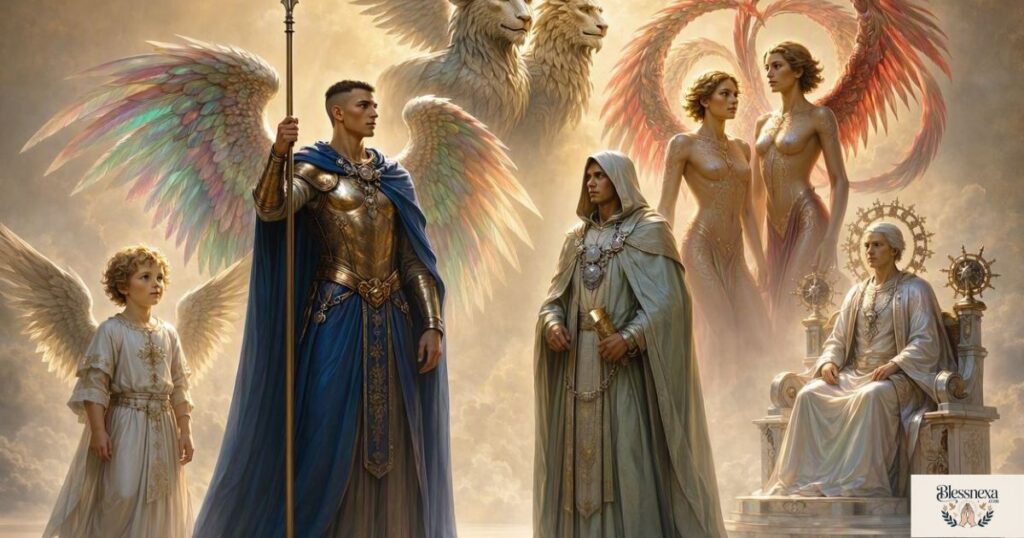
- The following categories are among the most important when studying biblically accurate angels:
- Angels: Messengers and servants who carry out God’s commands.
- Archangel: A term associated with a chief or leading angelic figure.
- Seraphim: Six-winged heavenly beings described in Isaiah 6.
- Cherubim: Powerful guardians associated with God’s holiness and presence.
- Living creatures: Mysterious beings described prominently in Ezekiel and Revelation.
- Fallen angels: Spiritual beings associated with rebellion against God in several biblical passages.
- These descriptions should be studied individually rather than blended into one generic angel.
- Doing so produces a more accurate understanding of biblical imagery.
4. Seraphim: The Six-Winged Beings Around God’s Throne
- The clearest description of seraphim appears in Isaiah 6.
- Isaiah sees the Lord seated on a high and exalted throne.
- Seraphim stand above Him.
- Each seraph has six wings.
- Two wings cover the face.
- Two wings cover the feet.
- Two wings are used for flying.
- They continually proclaim God’s holiness.
- Their famous declaration emphasizes that the Lord is holy and that His glory fills the earth.
- This is one of the strongest examples of what biblically accurate angels can look like when the specific being is a seraph.
- The description is far removed from the typical two-winged angel seen in greeting cards.
- Seraphim are associated with worship, holiness, and the divine throne.
- Their appearance communicates reverence rather than cuteness.
- Their six wings also distinguish them from ordinary messenger angels.
- The Hebrew word seraphim is commonly connected with the idea of burning or fiery beings.
- Isaiah’s vision also includes the altar, coal, smoke, and overwhelming holiness.
- The entire scene communicates God’s majesty.
- Therefore, seraphim should not be portrayed simply as ordinary angels with extra wings.
- Their biblical context is specifically connected to God’s throne and worship.
5. Cherubim: Powerful Guardians of Sacred Space
- Cherubim are among the most misunderstood heavenly beings in modern culture.
- Many people imagine a cherub as a small, chubby baby with tiny wings.
- That image does not come from the detailed biblical descriptions.
- Scripture presents cherubim as powerful and awe-inspiring beings.
- In Genesis 3:24, cherubim are placed east of Eden after humanity is expelled from the garden.
- A flaming sword guards the way to the tree of life.
- Cherubim are also connected with the tabernacle and temple imagery.
- Exodus describes cherubim over the mercy seat of the ark.
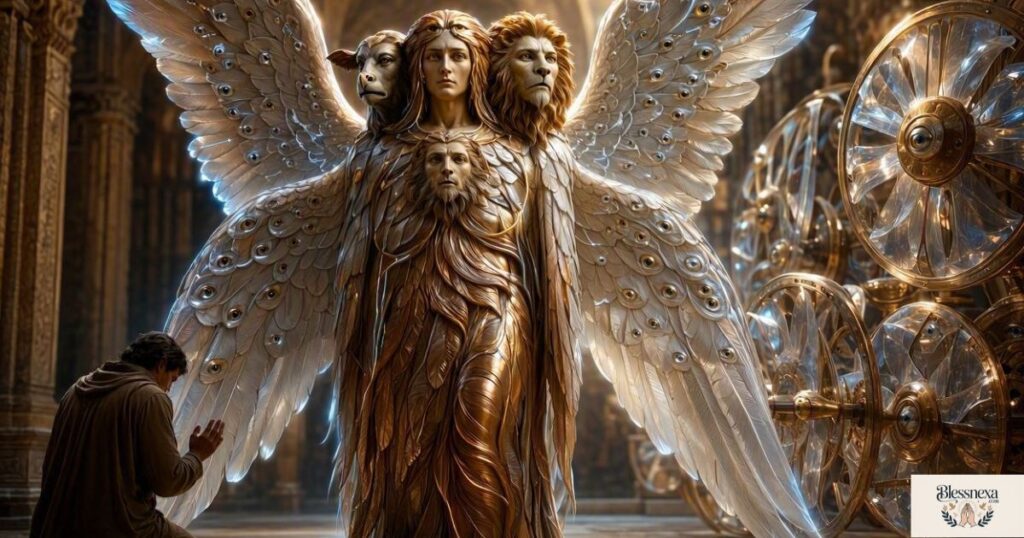
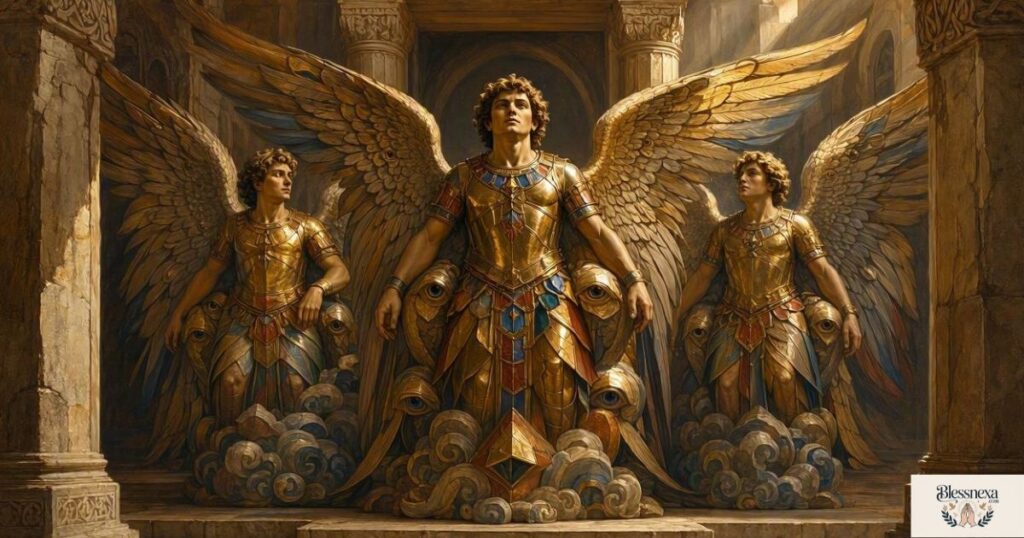
- Ezekiel provides some of the most extraordinary descriptions of cherubim.
- The prophet sees creatures associated with four faces, four wings, human-like hands, straight legs, and unusual feet.
- Ezekiel later identifies these creatures as cherubim.
- Their movement is closely connected with wheels in the vision.
- Their bodies and wings are covered with eyes in various parts of the vision’s imagery.
- This imagery is highly symbolic and difficult to translate into ordinary physical categories.
- Nevertheless, it clearly differs from the baby-like cherub commonly found in Western art.
- When creating biblically accurate angels, cherubim should therefore be treated as a separate and much more powerful category.
- Their connection with God’s glory and sacred space is central to their biblical identity.
What the Cherubim Symbolize
- Cherubim are strongly associated with God’s presence.
- Their placement near sacred locations emphasizes holiness and restricted access.
- The imagery communicates divine authority and protection.
- In Ezekiel, cherubim are closely connected with God’s glory.
- They are not independent gods.
- They do not compete with God.
- They serve within God’s authority.
- This distinction is important because biblical angels never become objects of worship.
- Revelation repeatedly demonstrates that heavenly beings direct worship toward God rather than themselves.
- Therefore, the grandeur of cherubim should point the viewer toward God’s glory, not make the creature itself divine.
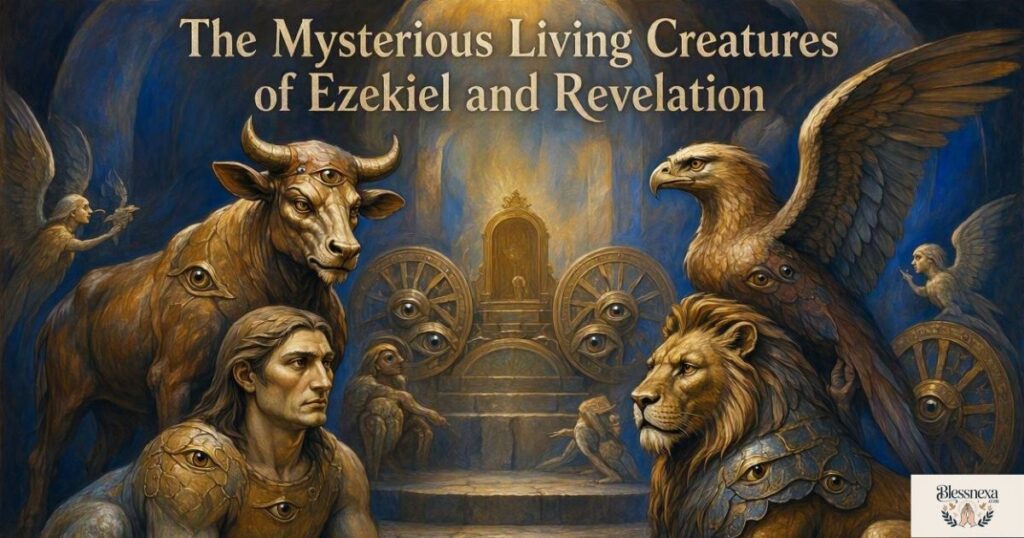
6. The Mysterious Living Creatures of Ezekiel and Revelation
- Another fascinating category appears in the visions of Ezekiel and Revelation.
- Ezekiel 1 describes four living creatures with multiple faces, wings, and extraordinary movement.
- Their appearance is difficult to compare with ordinary animals or humans.
- Each creature has multiple faces representing different beings.
- The vision also includes wheels associated with the creatures.
- The wheels have a remarkable appearance and are described as being full of eyes.
- Ezekiel later connects these creatures with cherubim.
- Revelation also describes four living creatures around God’s throne.
- These creatures are covered with eyes and continually worship God.
- Revelation 4 gives them distinct appearances resembling a lion, ox, human being, and flying eagle.
- Because of these descriptions, some readers connect the Revelation creatures with Ezekiel’s cherubim.
- Others emphasize differences between the passages.
- Either way, these visions demonstrate why the biblical world of heavenly beings is far more diverse than popular artwork suggests.
- A literal-looking illustration should therefore avoid pretending that every mysterious detail has an obvious modern equivalent.
- Some biblical visions intentionally communicate heavenly realities through symbolic imagery.
- The safest approach is to preserve the scriptural details while acknowledging areas of interpretation.
7. Archangels: What Does the Bible Actually Say?
- The Bible uses the word archangel specifically and sparingly.
- Michael is explicitly called an archangel in Jude 9.
- First Thessalonians 4:16 also mentions an archangel’s voice in connection with the return of Christ.
- Michael is portrayed as a powerful heavenly defender.
- Daniel presents Michael as a great prince who stands for God’s people.
- Revelation 12 describes Michael and his angels fighting against the dragon and his angels.
- These passages associate Michael with spiritual conflict and heavenly authority.
- However, Scripture does not provide a complete list of archangels.
- It also does not teach that Michael is stronger than God or independently controls heaven.
- His authority remains subordinate to God.
- Some Christian traditions identify other named angels as archangels, but those conclusions depend partly on traditions and texts outside the Protestant biblical canon.
- Gabriel is prominent in Scripture, especially in Daniel and Luke.
- However, the Bible does not explicitly call Gabriel an archangel.
- This distinction matters when discussing biblically accurate angels.
- A claim can sound traditional while still lacking a direct biblical statement.
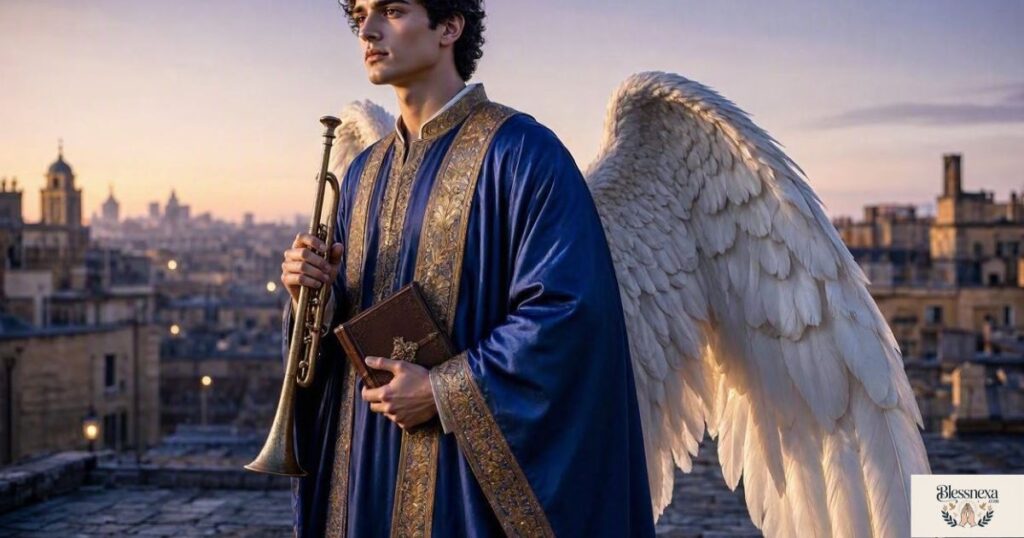
8. Gabriel Was a Messenger With an Extraordinary Mission
- Gabriel is one of the few angels named directly in the Bible.
- He appears in Daniel to explain visions.
- Centuries later, Gabriel appears in Luke’s Gospel.
- He announces the birth of John the Baptist to Zechariah.
- He later announces to Mary that she will give birth to Jesus.
- Gabriel’s biblical role is strongly connected with delivering important messages from God.
- Scripture does not describe him with the dramatic multi-faced appearance associated with Ezekiel’s creatures.
- Nor does it explicitly identify him as an archangel.
- This makes Gabriel a useful example of why different angelic descriptions should not be blended together.
- His authority comes from the message he carries.
- The focus remains on God’s plan rather than Gabriel’s personal power.
- His appearances also show that angels can communicate directly with humans during significant moments in salvation history.
9. Angels in the Life, Death, and Resurrection of Jesus
- Angels play important roles throughout the earthly ministry of Jesus.
- They appear during His birth narrative.
- An angel announces His birth to shepherds in Luke 2.
- A multitude of heavenly beings praises God after the announcement.
- Angels also appear after Jesus’ temptation in the wilderness.
- Matthew 4:11 says angels ministered to Him.
- During His agony before the crucifixion, Luke 22:43 records an angel strengthening Jesus.
- At the resurrection, angels announce that Jesus has risen.
- Matthew describes an angel at the tomb.
- Mark describes a young man in white.
- Luke describes two men in dazzling clothing.
- John also describes two angels at the tomb.
- These accounts show that angels are closely connected with major events surrounding Christ.
- Yet they never replace Christ as the central figure.
- Their role is supportive, declarative, and obedient to God’s purpose.
- This is an important principle when interpreting biblical angel stories.
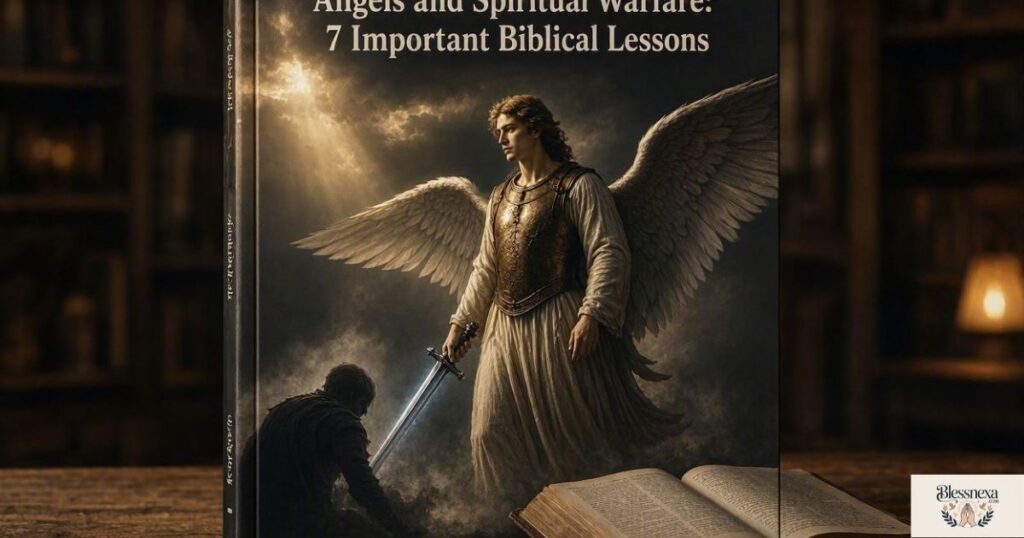
10. Angels and Spiritual Warfare: 7 Important Biblical Lessons
- The Bible presents spiritual conflict as a genuine part of its worldview.
- Daniel 10 describes conflict involving heavenly beings and spiritual opposition.
- Michael appears as a defender in this context.
- Revelation 12 portrays Michael and his angels fighting against the dragon.
- However, Scripture never encourages people to obsess over angels or attempt to control them.
- Spiritual warfare remains under God’s authority.
- Ephesians 6 directs believers toward God’s armor rather than fascination with supernatural beings.
- Biblical teaching therefore emphasizes faithfulness to God rather than angelic speculation.
- The following principles summarize the biblical pattern:
- God remains supreme: No angel possesses independent divine authority.
- Angels serve God’s purposes: Their actions are connected to His commands.
- Spiritual conflict exists: Scripture portrays opposition between faithful and rebellious spiritual beings.
- Michael fights under God’s authority: His power does not make him divine.
- Humans should not worship angels: Revelation explicitly warns against this.
- God provides protection: Biblical protection ultimately comes from God.
- Faith should remain Christ-centered: Angels point toward God’s work rather than becoming the focus.
11. Do All Biblically Accurate Angels Have Wings?
- No, Scripture does not say that every angel has wings.
- This is one of the most common misunderstandings about angels.
- Seraphim clearly have six wings.
- Cherubim are also described with wings.
- However, many ordinary messenger angels are described without explicit mention of wings.
- When Gabriel appears to Daniel and later to Zechariah and Mary, the text does not give him a standard pair of wings.
- The same principle applies to angels appearing at the tomb.
- Their supernatural nature does not automatically require visible wings.
- Therefore, an image of a wingless messenger angel can still be consistent with biblical descriptions.
- Likewise, a six-winged seraph can be biblically appropriate when the context is Isaiah 6.
- The important question is not whether an artist included wings.
- The important question is whether the design matches the particular biblical being being represented.
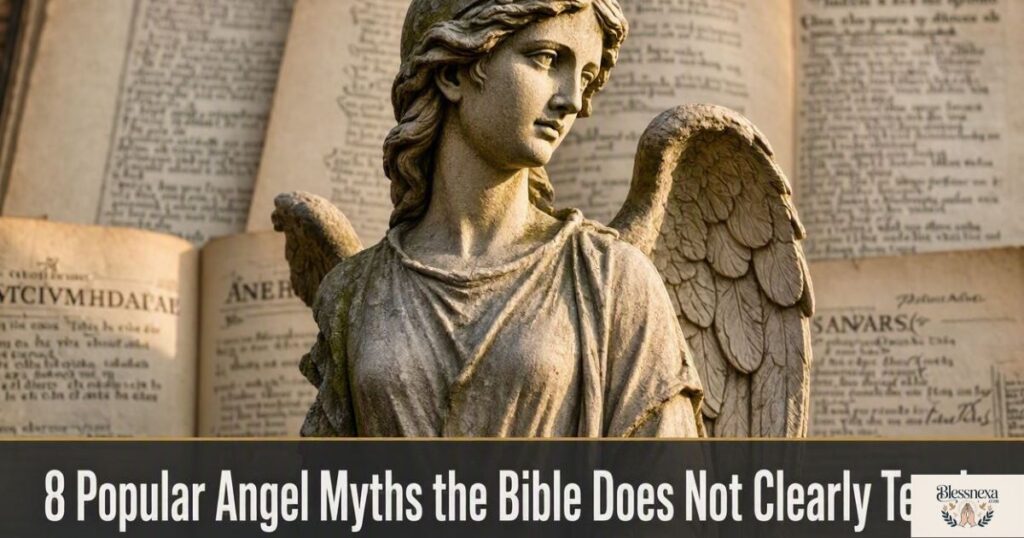
12. 8 Popular Angel Myths the Bible Does Not Clearly Teach
- Many popular ideas about angels come from tradition, art, folklore, or later literature.
- Some ideas may contain elements that Christians find meaningful.
- However, they should not automatically be presented as direct biblical teaching.
- Here are several common examples:
- Every angel has two wings: Scripture does not teach this.
- Angels always look like beautiful women: Biblical messenger angels are often described in masculine or human-like terms.
- Cherubs are babies: Biblical cherubim are powerful heavenly beings.
- People become angels after death: Scripture distinguishes humans from angels.
- Every person has one personal guardian angel: Scripture contains passages about angelic protection, but does not clearly establish this universal formula.
- Angels are omniscient: Angels are powerful creatures, not God.
- Angels should receive prayers: Biblical worship belongs to God.
- Angels have independent supernatural authority: Their authority remains under God.
- Removing these assumptions makes the study of biblically accurate angels much more interesting.
- The biblical descriptions are already extraordinary without adding folklore.
13. Guardian Angels: What Does Scripture Really Say?
- The idea of guardian angels is deeply rooted in Christian tradition.
- Scripture does contain passages that suggest angels can protect, serve, and assist God’s people.
- Psalm 91:11 says God commands His angels concerning His people.
- Jesus also speaks about angels connected with children in Matthew 18:10.
- Hebrews 1:14 describes angels as ministering spirits sent to serve those who will inherit salvation.
- These passages provide a biblical foundation for angelic ministry.
- However, Scripture does not give every person a detailed biography of one assigned guardian angel.
- It also does not encourage people to communicate with angels as though they were independent spiritual guides.
- God’s protection remains the central theme.
- Therefore, Christians can affirm angelic ministry without building an elaborate system beyond what Scripture says.
14. Fallen Angels and the Reality of Spiritual Rebellion
- The Bible also speaks about spiritual beings who rebelled against God.
- Several passages contribute to the biblical picture of spiritual rebellion.
- Second Peter 2:4 refers to angels who sinned and were judged.
- Jude 6 speaks of angels who did not keep their proper position.
- Revelation 12 portrays Satan and his angels in opposition to God.
- These passages establish the reality of rebellious spiritual beings.
- However, some popular explanations combine several biblical passages into a single detailed story that Scripture itself does not explicitly present.
- For example, Isaiah 14 and Ezekiel 28 are sometimes treated as complete biographies of Satan’s fall.
- Their immediate contexts concern earthly kings, although Christians have historically connected their imagery with Satan.
- Therefore, careful Bible study should distinguish direct statements from theological interpretations.
- This approach creates a more reliable understanding of fallen angels and demons.
15. Is Satan a Biblically Accurate Angel?
- Scripture identifies Satan as a spiritual adversary rather than presenting him as a cartoonish red creature with horns.
- The Bible uses imagery and titles that describe him as an enemy, accuser, tempter, and deceiver.
- Revelation calls him the dragon and ancient serpent.
- These descriptions are theological and symbolic as well as vivid.
- Scripture does not give a simple portrait of Satan with the familiar horns, pitchfork, and red skin found in popular art.
- The Bible also does not describe Satan as God’s equal.
- God remains infinitely superior.
- Satan is a created being who opposes God’s purposes.
- This distinction is essential.
- Christian theology should never treat Satan as an evil counterpart equal to God.
- Biblical spiritual conflict is not a battle between two equally powerful gods.
- It is rebellion against the sovereign Creator.
16. Angels Are Not Gods
- Scripture makes a sharp distinction between the Creator and His creatures.
- Angels may possess extraordinary power, knowledge, and access to the heavenly realm.
- Nevertheless, they remain created beings.
- Revelation 19 and 22 show how even a heavenly messenger can reject worship directed toward himself.
- When John falls before an angel, the angel tells him to worship God.
- This is one of the clearest warnings against angel worship.
- The lesson is straightforward:
- Angels serve God.
- Angels do not replace God.
- Angels are not objects of worship.
- Angels do not possess God’s unlimited attributes.
- Angels remain under divine authority.
- This biblical distinction protects the meaning of biblically accurate angels from drifting into mythology.
- Their greatness ultimately highlights the greatness of their Creator.
17. 5 Things Angels Cannot Do Like God
- Angels are powerful, but Scripture never presents them as divine equals.
- Their limitations become clearer when compared with God’s unique attributes.
- Angels are not omnipotent: They do not possess unlimited power.
- Angels are not omniscient: Scripture even indicates that certain divine mysteries were not fully known to angels.
- Angels are not omnipresent: They are created beings rather than beings present everywhere simultaneously.
- Angels are not creators of the universe: Creation belongs to God.
- Angels are not worthy of worship: Scripture repeatedly directs worship toward God.
- These distinctions help readers avoid exaggerating angelic powers.
- A biblically grounded depiction can make an angel impressive without making the angel divine.
18. Why Popular Culture Gets Angels Wrong
- Movies and fantasy stories often combine biblical imagery with artistic invention.
- This is not necessarily wrong in fiction.
- Problems arise when fictional imagery is presented as though it were a direct description from Scripture.
- Popular artwork usually gives angels:
- Two large feathered wings.
- Human faces.
- White robes.
- Golden halos.
- Perfectly attractive features.
- Glowing bodies.
- Feminine appearances.
- Some of these details come from centuries of artistic tradition rather than specific biblical verses.
- The halo, for example, became an important artistic symbol for holiness but is not presented as a physical feature of angels in Scripture.
- Likewise, the familiar romantic image of angels as beautiful women does not represent the standard biblical descriptions.
- A better approach is to distinguish biblical description, Christian artistic tradition, and modern fantasy.
- These categories can overlap, but they are not identical.
19. Biblically Accurate Angels vs. Modern Angel Art
| Feature | Biblical Evidence | Common Popular Image |
| Human appearance | Some angels appear human-like | Usually human-like |
| Wings | Explicit for some heavenly beings | Almost always included |
| Two wings | Not universal | Standard design |
| Six wings | Explicitly associated with seraphim | Rarely shown |
| Multiple faces | Associated with cherubim in Ezekiel | Rare |
| Eyes | Prominent in some visions | Usually absent |
| Halo | Not explicitly described | Common |
| Gendered appearance | Biblical texts often use masculine language for messengers | Often feminine |
| Worship | Angels direct worship to God | Sometimes treated as spiritual icons |
| Role | Messengers, servants, warriors, worshipers | Often portrayed mainly as protectors |
This comparison shows why the phrase biblically accurate angels needs context.- Scripture contains multiple descriptions rather than one standardized angel design.
- An artist can therefore be accurate while creating very different-looking heavenly beings.
- Accuracy depends on which passage is being represented.
20. 7 Bible Passages Worth Reading for Angel Studies
- Genesis 3:24: Cherubim guard the way to the tree of life.
- Genesis 18–19: Heavenly visitors interact with Abraham and Lot.
- Isaiah 6:1–7: Seraphim worship around God’s throne.
- Ezekiel 1 and 10: Extraordinary creatures and cherubim appear in prophetic visions.
- Daniel 10: A powerful heavenly messenger appears during Daniel’s vision.
- Revelation 4: Living creatures worship around God’s throne.
- Revelation 12: Michael and his angels fight against the dragon and his angels.
- Reading these passages directly is more valuable than depending entirely on modern illustrations.
- Context matters because biblical imagery often communicates theological truths through visions.
- A careful reader should therefore compare descriptions across passages instead of building doctrine from a single artistic interpretation.
21. How to Create a Biblically Accurate Angel Illustration
- If you are creating artwork, an animation, a thumbnail, or educational material, begin with the specific passage.
- Do not start with a generic angel picture.
- First determine which heavenly being the scene represents.
- Then identify every physical detail Scripture provides.
- For example, an Isaiah 6 illustration should reflect six wings and the throne-room setting.
- An Ezekiel vision should preserve the unusual creature and wheel imagery described in the text.
- A messenger scene may use a human-like appearance if the relevant passage supports it.
- Keep the following process in mind:
- Step 1: Choose the biblical passage.
- Step 2: Identify the specific heavenly being.
- Step 3: List every physical detail explicitly mentioned.
- Step 4: Separate direct description from interpretation.
- Step 5: Avoid adding popular features without biblical support.
- Step 6: Preserve the atmosphere of the original passage.
- Step 7: Make God’s glory the theological center.
- This method produces stronger results than simply searching for an image labeled “biblically accurate angel.”
22. The Most Important Difference: Appearance vs. Purpose
- Much of the online discussion about biblically accurate angels focuses on frightening appearances.
- That can be entertaining, but appearance is only one part of the biblical picture.
- Scripture spends significant attention on what angels do.
- They serve God.
- They deliver messages.
- They worship.
- They protect according to God’s commands.
- They participate in divine judgment.
- They strengthen or assist God’s servants.
- They fight in spiritual conflict.
- They announce major events.
- Their activity consistently points beyond themselves.
- Therefore, the most accurate representation of an angel should communicate both appearance and purpose.
- A frightening design without biblical function is incomplete.
- Likewise, a beautiful design that ignores the biblical context can also be misleading.
23. 10 Powerful Biblical Truths About Angels
- Angels are created beings: They are part of God’s creation rather than eternal gods.
- Angels serve God: Their authority comes from the Creator.
- Angels can deliver messages: This is reflected in the meaning of the word itself.
- Some angels appear human: Biblical narratives repeatedly show this possibility.
- Some heavenly beings have wings: Seraphim and cherubim provide clear examples.
- Not every angel is described with wings: Scripture does not establish wings as a universal requirement.
- Angels can participate in spiritual warfare: Michael is the clearest biblical example.
- Angels should not be worshiped: Revelation strongly emphasizes this point.
- Angels do not replace God: They remain servants and created beings.
- Angelic activity ultimately points toward God: Their biblical purpose is connected with His will and glory.
24. Are Biblically Accurate Angels Supposed to Be Scary?
- Some biblical heavenly beings would certainly appear terrifying or overwhelming to modern observers.
- Isaiah’s vision involves seraphim, smoke, thunderous proclamation, and divine holiness.
- Ezekiel’s visions contain creatures and wheels unlike ordinary earthly forms.
- Daniel’s supernatural encounters produce fear and physical weakness.
- Yet not every angelic encounter is described as horrifying.
- Angels sometimes appear as ordinary human-like visitors.
- Their first words are also frequently reassuring.
- In several Gospel accounts, people are frightened by the supernatural encounter rather than necessarily by an ugly physical appearance.
- Therefore, “scary angel” is an incomplete category.
- The better description is supernatural, powerful, glorious, and sometimes overwhelming.
- The emotional response depends on the particular encounter.
25. Why Do People Find the Biblical Descriptions So Strange?
- The Bible’s unusual angelic imagery often comes from prophetic visions.
- Prophets were describing realities beyond ordinary human experience.
- Ezekiel’s wheels, creatures, eyes, and movement are especially difficult to visualize.
- Revelation also uses highly symbolic imagery.
- These passages may communicate theological truths through visual symbols rather than function as technical biological descriptions.
- That does not make them meaningless.
- Instead, the imagery invites careful interpretation.
- The strange appearance can communicate God’s holiness, authority, judgment, movement, and heavenly glory.
- Therefore, readers should resist the temptation to reduce every symbol to a simple creature design.
- Biblical accuracy sometimes means preserving mystery rather than pretending every detail has been scientifically explained.
26. Do Angels Have Free Will?
- Scripture presents angels as moral creatures capable of obedience or rebellion.
- The existence of fallen angels demonstrates that at least some spiritual beings rebelled against God.
- Jude 6 and 2 Peter 2:4 refer to angels who sinned.
- Revelation also presents Satan’s angels in rebellion.
- At the same time, faithful angels consistently appear as servants of God.
- The Bible does not provide a complete philosophical explanation of angelic free will.
- It also does not answer every question about whether their choices function exactly like human choices.
- Therefore, it is safest to say that Scripture presents angels as morally accountable spiritual beings.
- Their loyalty or rebellion has consequences.
- This is more firmly grounded than attempting to construct an elaborate theory beyond the biblical text.
27. Can Humans Become Angels After Death?
- A common cultural idea says that people become angels after they die.
- However, Scripture does not teach that humans transform into angels.
- Angels and humans are presented as distinct categories of created beings.
- Hebrews discusses angels as ministering spirits.
- Human beings have a different place within God’s creation and redemption story.
- Jesus’ teaching about the resurrection also does not say that resurrected people become angels.
- Instead, He says that resurrected people are like angels in certain respects, particularly concerning marriage.
- Therefore, saying “a person became an angel” is comforting language in popular culture, but it should not be presented as a direct biblical teaching.
- Biblical hope centers on resurrection and life with God rather than becoming an angel.
28. Can Angels Read Human Thoughts?
- Scripture does not clearly teach that angels can read every human thought.
- Angels possess knowledge and observe events, but they are not described as omniscient.
- God alone is presented as knowing the depths of the human heart perfectly.
- First Kings 8:39 emphasizes God’s unique knowledge of human hearts.
- Therefore, claims that angels automatically know every private thought should be treated cautiously.
- Biblical descriptions emphasize their service rather than unlimited supernatural abilities.
- This distinction also prevents angels from being treated as divine surveillance beings.
- Their knowledge remains creaturely and limited compared with God’s knowledge.
29. Can People See Angels Today?
- The Bible contains many accounts of people seeing angels.
- However, Scripture does not establish a rule that every supernatural experience today is an angelic visitation.
- Hebrews 13:2 encourages hospitality by noting that some people have entertained angels without knowing it.
- That verse emphasizes hospitality rather than providing a method for identifying angels.
- Therefore, Christians should exercise discernment when someone claims to have encountered an angel.
- A supernatural experience should never automatically override Scripture.
- Nor should every unusual event be interpreted as an angelic intervention.
- The Bible consistently places greater importance on God’s revealed truth than on extraordinary experiences.
30. 8 Mistakes to Avoid When Studying Biblical Angels
- Starting with movies: Begin with Scripture instead.
- Assuming every angel has wings: Check the actual passage.
- Calling cherubim babies: Read Genesis, Exodus, Ezekiel, and related passages.
- Treating artistic tradition as Scripture: Art can illustrate theology without being biblical evidence.
- Inventing angel rankings: Distinguish biblical categories from later traditions.
- Worshiping angels: Scripture explicitly rejects angel worship.
- Making angels equal to God: They remain created beings.
- Ignoring context: Prophetic visions often contain symbolism that requires careful interpretation.
- These mistakes can make an interesting subject confusing.
- A passage-by-passage approach keeps the study grounded.
31. What Makes an Angel Illustration Truly Biblical?
- Biblical accuracy is not simply about making an angel look frightening.
- It means respecting what the biblical text actually says.
- A good illustration should match the specific passage.
- It should not automatically combine cherubim, seraphim, messenger angels, and Revelation creatures into one design.
- It should also avoid adding features simply because they are popular.
- Most importantly, the illustration should preserve the theological message.
- If the scene is about worship, the composition should communicate worship.
- If it concerns a messenger, the figure should communicate authority and purpose.
- If it depicts a prophetic vision, unusual imagery may be appropriate.
- In this sense, the best biblically accurate angels are not necessarily the most frightening ones.
- They are the ones most faithful to the biblical context.
32. A Simple Biblical Angel Study Guide
- Start with Isaiah 6: Study the six-winged seraphim.
- Read Genesis 3: Examine the role of cherubim.
- Read Exodus 25: Observe how cherubim appear in tabernacle imagery.
- Study Ezekiel 1: Examine the mysterious living creatures.
- Study Ezekiel 10: Note the connection between the creatures and cherubim.
- Read Daniel 10: Study angelic appearance and spiritual conflict.
- Read Luke 1: Compare Gabriel’s appearances and messages.
- Read Hebrews 1: Understand angels as ministering spirits.
- Read Revelation 4: Examine the living creatures around God’s throne.
- Read Revelation 12: Study Michael and spiritual warfare.
- Read Revelation 19 and 22: Notice the warning against worshiping angels.
- This sequence gives readers a strong biblical foundation without depending on popular imagery.
FAQs
How do biblically accurate angels look?
Biblically accurate angels do not have one universal appearance. Some angels appear in human-like form, while other heavenly beings are described with wings, multiple faces, eyes, or unusual features. Seraphim have six wings, while cherubim receive much more complex descriptions in Ezekiel. Therefore, the correct appearance depends on the specific biblical being and passage.
What are the biblically accurate types of angels?
The Bible mentions angels, an archangel, seraphim, cherubim, and mysterious living creatures. Some passages also discuss rebellious or fallen angels. However, Scripture does not provide a complete hierarchy containing every category found in later Christian traditions. The safest approach is to distinguish what the Bible explicitly says from later theological systems.
Who is God’s strongest angel?
Michael is presented as a powerful heavenly figure and is explicitly called an archangel. Daniel describes him as a great prince, while Revelation portrays him leading angels in battle against the dragon. However, the Bible does not say that Michael is God’s strongest angel in a complete ranking system. God remains supreme over every angelic being.
Do biblically accurate angels have wings?
Some do, but Scripture does not say every angel has wings. Seraphim have six wings in Isaiah 6, while cherubim are described with wings in several passages. Many messenger angels are simply described as appearing like men without their wings being mentioned. Therefore, wings should not be treated as a universal requirement.
What is the biggest sin that God will never forgive?
Jesus speaks about blasphemy against the Holy Spirit as a uniquely serious sin in Matthew 12:31–32 and Mark 3:28–30. Christian interpretations differ on the precise nature of this sin. It is commonly understood as persistent, deliberate rejection of God’s revealed truth rather than an accidental statement or ordinary mistake. The surrounding biblical context is essential.
How can you tell if a human is an angel?
The Bible does not provide a reliable human method for identifying an angel disguised as a person. Hebrews 13:2 says that some people have entertained angels without knowing it, emphasizing hospitality rather than an identification test. Therefore, unusual kindness, appearance, or behavior should not automatically be interpreted as proof that someone is an angel.
Are angels mentioned in the Bible more than people realize?
Yes. Angels appear throughout both the Old and New Testaments. They are involved in major events, including prophetic visions, divine messages, spiritual conflict, the ministry of Jesus, the resurrection, and events described in Revelation. However, their appearances always need to be interpreted in context rather than combined into one generic angelic image.
Should Christians pray to angels?
Biblical teaching points worship and prayer toward God rather than angels. Revelation 19 and 22 provide especially clear examples in which an angel refuses worship and directs attention back to God. Angels may serve God’s people, but Scripture does not present them as replacements for God or as independent objects of prayer and worship.
Conclusion
The biblical picture of biblically accurate angels is far richer than the familiar image of a beautiful person with two white wings. Scripture describes ordinary-looking messengers, six-winged seraphim, powerful cherubim, mysterious living creatures, and heavenly warriors. These beings differ in appearance and function, yet they share one central characteristic: they operate under God’s authority.
The most important lesson is not that angels are frightening, beautiful, or mysterious. It is that they are servants of the Creator. They deliver messages, worship God, protect according to His command, participate in spiritual conflict, and announce important moments in His plan.
So, when studying biblically accurate angels, start with Scripture rather than popular artwork. Read the passages carefully, distinguish direct descriptions from later traditions, and allow the mystery of biblical heavenly beings to remain where Scripture leaves it. The result is a deeper understanding of angels—and, ultimately, a greater appreciation of the God they serve.

welcome to blessnexa I am Muhammad inam an ai powered seo and content writer with 4 years of experienceI help website rank higher , grow traffic ,and look amazing ,my goal is to make SEO and web design simple andeffective for everyone .lets achieve more togather