
When you face an important decision, uncertainty can make even a simple choice feel difficult. Islam offers a beautiful way to seek Allah’s guidance while placing your trust in Him. Dua e Istikhara is a well-known Sunnah supplication connected with Salat al-Istikhara. It teaches a believer to ask Allah to facilitate what is good and turn away what is harmful.
This practice is not about predicting the future or waiting for a mysterious sign. Instead, it is about asking Allah, who knows what we cannot know, to guide us toward what is beneficial for our faith, life, and future. It also develops tawakkul, patience, humility, and sincere dependence upon Allah.
In this comprehensive guide, you will learn the meaning of Istikhara, its Prophetic basis, the complete dua, how to perform the prayer, what to expect afterward, and which common misunderstandings should be Dua e Istikhara
What Istikhara Really Means in Islam
- The Arabic word Istikhara comes from a root associated with seeking goodness or what iDua e Istikhara
- In practical terms, Istikhara means asking Allah to choose what is good for you when you are uncertain about a permissible Dua e Istikhara
- The heart of the practice is not simply receiving an answer. Rather, it is surrendering your decision to the One who has complete Dua e Istikhara
- Therefore, dua e istikhara should be understood as an act of worship and reliance, rather than a supernatural method for discovering hiddeDua e Istikhara
- A believer may use Istikhara when considering matters such as marriage, employment, education, travel, business, relocation, or another significant permissible Dua e Istikhara
- However, Istikhara does not apply to matters that are already clearly obligatory or clearlyDua e Istikhara
- For example, a Muslim does not need Istikhara to decide whether to perform an obligatory prayer or avoid something Allah hasDua e Istikhara
- The practice becomes especially meaningful when several permissible options exist and you genuinely do not know which one may beDua e Istikhara
- It encourages a person to combine Islamic guidance, thoughtful consideration, consultation, and sincere Dua e Istikhara
Why Dua e Istikhara Matters When You Feel Uncertain
- Human beings naturally make decisions using limitedDua e Istikhara
- We may see today’s circumstances, but we cannot see every consequence that could follow yearDua e Istikhara
- Allah, however, has complete knowledge of what has happened, what is happening, and what willDua e Istikhara
- That difference explains why seeking divine guidance can bring spiritual balance to difficultDua e Istikhara
- Dua e istikhara reminds the believer that personal preference should not become more important than what Allah knows to beDua e Istikhara
- It also helps reduce excessive attachment to a particular Dua e Istikhara
- Sometimes we strongly desire something because it looks attractive from the Dua e Istikhara
- Yet circumstances can change, hidden difficulties can appear, or the opportunity may not be suitable for us.
- At other times, we may fear something that eventually proves Dua e Istikhara
- Istikhara teaches us to ask Allah for what is good rather than demanding that a specific outcome Dua e Istikhara
- This attitude develops trust in Allah, even when the answer does not match our originalDua e Istikhara
The Prophetic Foundation Behind Istikhara
- The practice of Istikhara is established through the teachings of Prophet Muhammad ﷺ.
- A well-known narration from Jabir ibn Abdullah رضي الله عنه explains that the Prophet ﷺ taught his companions Istikhara for matters in much the same way that he taught them a Surah from the Qur’an.
- The narration is recorded in Sahih al-Bukhari, making it an important source for understanding the practice.
- The hadith describes a two-rak’ah prayer followed by the supplication in which the believer asks Allah for goodness through His knowledge and Dua e Istikhara
- This Prophetic foundation is important because it shows that Istikhara is not merely a cultural custom.
- It is connected to the Sunnah of the Prophet ﷺ.
- The hadith also demonstrates the importance of turning to Allah when making meaningfulDua e Istikhara
- Therefore, a person should approach Istikhara with sincerity rather than treating it as a ritual designed to produce a dramatic Dua e Istikhara
Dua e Istikhara in Arabic
- The following is the well-known supplication reported in the hadith of Jabir رضي الله عنه:
- اللَّهُمَّ إِنِّي أَسْتَخِيرُكَ بِعِلْمِكَ، وَأَسْتَقْدِرُكَ بِقُدْرَتِكَ، وَأَسْأَلُكَ مِنْ فَضْلِكَ الْعَظِيمِ، فَإِنَّكَ تَقْدِرُ وَلَا أَقْدِرُ، وَتَعْلَمُ وَلَا أَعْلَمُ، وَأَنْتَ عَلَّامُ الْغُيُوبِ.
- اللَّهُمَّ إِنْ كُنْتَ تَعْلَمُ أَنَّ هَذَا الْأَمْرَ خَيْرٌ لِي فِي دِينِي وَمَعَاشِي وَعَاقِبَةِ أَمْرِي، أَوْ قَالَ: عَاجِلِ أَمْرِي وَآجِلِهِ، فَاقْدُرْهُ لِي وَيَسِّرْهُ لِي، ثُمَّ بَارِكْ لِي فِيهِ، وَإِنْ كُنْتَ تَعْلَمُ أَنَّ هَذَا الْأَمْرَ شَرٌّ لِي فِي دِينِي وَمَعَاشِي وَعَاقِبَةِ أَمْرِي، أَوْ قَالَ: فِي عَاجِلِ أَمْرِي وَآجِلِهِ، فَاصْرِفْهُ عَنِّي وَاصْرِفْنِي عَنْهُ، وَاقْدُرْ لِيَ الْخَيْرَ حَيْثُ كَانَ، ثُمَّ أَرْضِنِي بِهِ.
- Because Arabic wording can be difficult for beginners, it is useful to learn the pronunciation gradually.
- When publishing this supplication online, it is wise to verify the Arabic text against a reliable hadith source before presentinDua e Istikhara
Dua e Istikhara Transliteration for Beginners
- Allahumma inni astakhiruka bi’ilmika, wa astaqdiruka bi-qudratika, wa as’aluka min fadlika al-‘azim.
- Fa-innaka taqdiru wa la aqdiru, wa ta’lamu wa la a’lamu, wa antaDua e Istikhara
- Allahumma in kunta ta’lamu anna hadhal-amra khairun li fi dini wa ma’ashi wa ‘aqibati amri, faqdurhu li wa yassirhu li, thumma barik li fihi.
- Wa in kunta ta’lamu anna hadhal-amra sharrun li fi dini wa ma’ashi wa ‘aqibati amri, fasrifhu ‘anni wasrifni ‘anhu, waqdur liyal-khaira haithu kana, thumma ardini bihi.
- The transliteration above is intended to help readers approach the Arabic Dua e Istikhara
- Transliteration systems can differ, so readers should not assume that every spelling variation represents a different Dua e Istikhara
- If possible, listen to a trustworthy Arabic recitation and learn the pronunciation from a qualifieDua e Istikhara
What the Dua Is Asking Allah to Do
- The supplication contains several profounDua e Istikhara
- First, the believer acknowledges Allah’s perfect Dua e Istikhara
- The phrase asking Allah to choose through His knowledge reflects the centraDua e Istikharal purposeDua e Istikhara
- Next, the believer recognizes that Allah has power while human ability isDua e Istikhara
- The supplication then asks for Allah’s immense Dua e Istikhara
- It also acknowledges that Allah knows the unseen while human knowledge remains incomplete.
- The believer then presents a particular matter to Allah.
- If Allah knows that the matter is good for the person’s religion, worldly life, and eventual outcome, the believer asks for it to be decreed, made easy, and blessed.
- If Allah knows that it is harmful, the believer asks that it be turned away and that the believer’s heart and path be turned away from it.
- Finally, the person asks Allah to provide goodness wherever it may be and grant contentment with that outcome.
- This final request is especially meaningful because sometimes the best outcome is not the one we originally wanted.
A Simple English Meaning of the Supplication
- The meaning of dua e istikhara centers on asking Allah to guide a person toward what is best.
- The believer says, in meaning, that Allah knows while the person does not know.
- The believer asks Allah to use His perfect knowledge and power to choose what is beneficial.
- If the particular matter is good for the person’s religion, livelihood, and ultimate outcome, the believer asks Allah to make it happen, make it easy, and place blessing in it.
- If the matter is harmful, the believer asks Allah to remove it from their path and remove them from it.
- The believer then asks Allah to decree goodness wherever it may be found and grant contentment with that goodness.
- This meaning shows that Istikhara is deeply connected with submission to Allah’s wisdom.
How to Perform Salat al-Istikhara Correctly
- The practical method is straightforward.
- First, make wudu and prepare yourself for prayer.
- Make a sincere intention to seek Allah’s guidance regarding a particular permissible matter.
- Pray two rak’ahs of voluntary prayer.
- After completing the prayer, recite the established Istikhara supplication.
- When you reach the words referring to “this matter,” have the particular decision in mind.
- You can identify the matter clearly in your heart.
- Then continue the supplication and ask Allah to make the beneficial path easy and blessed.
- If the matter is harmful, ask Allah to turn it away and turn your heart away from it.
- The goal is sincere reliance, not an attempt to force a particular answer.
Step 1: Prepare With Wudu and Sincere Intention
- Wudu prepares you physically and spiritually for salah.
- More importantly, approach the prayer with a sincere heart.
- Do not begin while treating Istikhara as a test that Allah must answer according to your preferred method.
- Instead, acknowledge that Allah knows what you cannot know.
- Think carefully about the matter before praying.
- If you are considering marriage, for example, understand the person’s character, values, responsibilities, and circumstances.
- If you are considering a job, investigate the workplace, duties, salary, environment, and long-term prospects.
- Istikhara should support responsible decision-making rather than replace it.
Step 2: Pray Two Rak’ahs
- Salat al-Istikhara involves two rak’ahs of voluntary prayer.
- Maintain the normal requirements of salah.
- Focus on your worship rather than becoming obsessed with what will happen afterward.
- There is no need to turn the prayer into something complicated.
- The important point is sincerity and following the established practice.
- The specific Surahs to recite in these two rak’ahs are not established as a required fixed pair in the authentic hadith describing Istikhara.
- Therefore, avoid presenting a particular Surah combination as mandatory without reliable evidence.
Step 3: Recite the Supplication
- After the two rak’ahs, recite the established supplication.
- Understand its meaning as much as possible.
- When you mention the matter in the dua, identify the decision clearly in your heart.
- You do not need dramatic language.
- You also do not need to repeat the request with anxiety until you feel a supernatural sensation.
- Instead, ask sincerely and leave the outcome to Allah.
- This is where dua e istikhara becomes an expression of tawakkul, rather than merely a formula.

Can You Read the Dua From Your Phone?
- Yes, a beginner may use a phone or written text to help learn the supplication.
- Many people initially struggle to remember a longer Arabic dua.
- Using a reliable text can therefore help with learning and pronunciation.
- However, it is better to gradually memorize the supplication if you can.
- A phone can also create distractions, so keep notifications away and use it only for the text you need.
- If you are uncertain about the correct Arabic wording, compare the text with a trusted hadith collection or qualified teacher.
When Is the Best Time to Perform Istikhara?
- There is no need to wait for a special dream or a particular mystical moment.
- Salat al-Istikhara can be performed when you genuinely need guidance concerning a permissible decision.
- Many people choose a quiet time when they can concentrate without interruptions.
- The general rules concerning voluntary prayer times should still be observed.
- If you want to perform Istikhara at night, you may choose an appropriate time for voluntary prayer.
- Some people prefer the last part of the night because it is a quiet period for worship.
- However, the value of the practice does not depend on a magical clock time.
What Should You Do After Istikhara?
- After dua e istikhara, continue using sound judgment.
- Gather relevant information.
- Consult trustworthy and knowledgeable people.
- Consider practical consequences.
- Pay attention to whether the matter becomes easier or more difficult through ordinary circumstances.
- Do not become paralyzed while waiting for an extraordinary sign.
- If you have responsibly considered the matter and circumstances point toward a reasonable decision, you can move forward while trusting Allah.
- If circumstances clearly close the door, you can accept that outcome without assuming that every inconvenience is a supernatural message.
- The believer’s responsibility is to make a sincere effort and trust Allah with the result.
Does Istikhara Require a Dream?
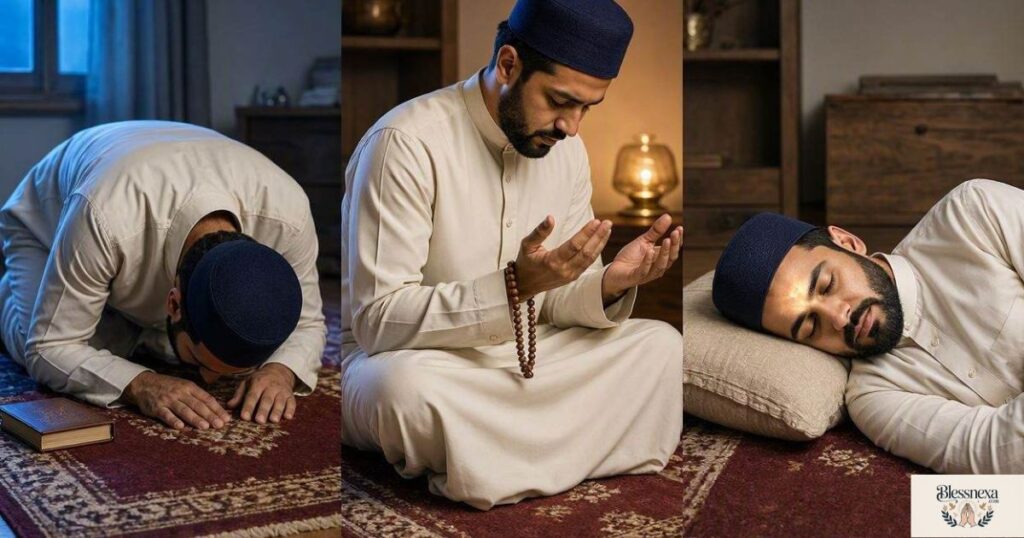
- No authentic requirement says that a person must receive a dream after performing Istikhara.
- This is one of the most common misunderstandings surrounding the practice.
- Some people expect to see a particular color, person, symbol, or scene while sleeping.
- Others believe a dream must reveal a direct yes-or-no answer.
- Such expectations can create unnecessary anxiety.
- A dream may occur, but a dream is not presented in the established hadith as the required method of receiving the result.
- Therefore, do not assume that Istikhara was unsuccessful simply because you did not dream.
- The practice is fundamentally about asking Allah for what is good and trusting His wisdom.

How Can You Recognize the Outcome?
- There is no universal checklist of signs that guarantees a particular interpretation.
- Instead, look at the situation realistically after making the dua.
- Consider whether the matter remains reasonably accessible.
- Examine whether new information changes your understanding.
- Seek advice from people whose judgment and character you trust.
- Notice whether you can proceed without violating Islamic principles.
- Most importantly, do not force every emotional change into a religious interpretation.
- Feeling excited does not automatically mean Allah has chosen something for you.
- Feeling nervous does not automatically mean it is forbidden or harmful.
- Human emotions naturally fluctuate.
- A balanced approach combines dua, consultation, evidence, and tawakkul.
A Practical Decision Framework After Istikhara
| Situation | Helpful Response |
| The option appears clearly permissible | Investigate it carefully and consider moving forward |
| Important negative information appears | Reassess the decision |
| The opportunity disappears | Accept the outcome and avoid unnecessary obsession |
| You remain uncertain | Seek further advice and information |
| Your emotions change repeatedly | Do not treat every emotion as a divine sign |
| Several options remain reasonable | Compare them carefully and ask Allah for guidance |
| The decision involves major risks | Get appropriate expert or professional advice |
| You fear making the wrong choice | Strengthen tawakkul and remember that Allah knows what you do not |
7 Situations Where Istikhara Can Be Especially Helpful
- Marriage decisions: When considering a potential spouse, Istikhara can accompany careful investigation and consultation.
- Career choices: A new job, business opportunity, or career direction may involve several unknown factors.
- Education: Choosing a field of study can influence many years of your life.
- Travel or relocation: Moving to another city or country can involve family, financial, and practical considerations.
- Business decisions: When entering a permissible business arrangement, seek advice and ask Allah for what is beneficial.
- Major purchases: A significant financial commitment can deserve both careful research and spiritual reflection.
- Other permissible choices: Any substantial matter involving uncertainty may become an occasion for sincere prayer.
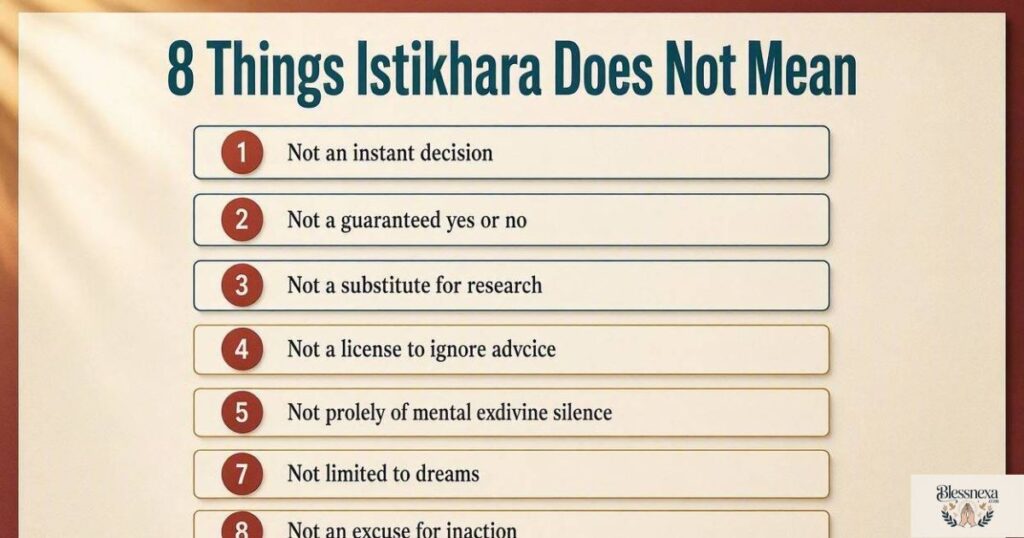
8 Things Istikhara Does Not Mean
- It does not mean predicting the future.
- It does not mean receiving guaranteed dreams.
- It does not replace research.
- It does not replace consultation.
- It does not make a prohibited action permissible.
- It does not guarantee the outcome you personally want.
- It does not require a mysterious feeling immediately afterward.
- It does not remove your responsibility to make sensible decisions.
Common Mistakes People Make With Istikhara
- Waiting for a dream: This creates expectations that the Sunnah does not require.
- Repeating it out of panic: Repetition should not become an anxiety-driven ritual.
- Ignoring facts: A person should not dismiss obvious evidence because they want a certain outcome.
- Seeking only emotional confirmation: Temporary excitement or fear is not a reliable religious sign.
- Using Istikhara for forbidden matters: Divine guidance is not sought to justify something already prohibited.
- Skipping consultation: Good advice remains valuable when making major decisions.
- Treating every obstacle as a sign: Ordinary problems can happen in every decision.
- Blaming Istikhara afterward: If something later becomes difficult, do not conclude that the prayer “failed.”
- Expecting certainty: The purpose is reliance upon Allah, not obtaining complete knowledge of the future.
Istikhara and Mashwara: Why Both Matter
- Mashwara, or consultation, complements Istikhara.
- A believer can seek Allah’s guidance while also asking wise and trustworthy people for advice.
- These practices address different needs.
- Istikhara connects the decision to Allah through worship and supplication.
- Consultation brings experience, knowledge, and another perspective.
- For example, someone considering a new business may pray Istikhara and then speak with an experienced business professional.
- Someone considering marriage may pray and also investigate character, compatibility, family circumstances, and responsibilities.
- This balanced approach is much stronger than relying on either spirituality or personal analysis alone.
How Istikhara Builds Tawakkul
- Tawakkul means relying upon Allah while taking appropriate means.
- It does not mean abandoning effort.
- A person can research a decision thoroughly and still recognize that the final outcome is beyond human control.
- Dua e istikhara teaches this balance beautifully.
- You investigate what you can.
- You ask people who can help.
- You make a thoughtful decision.
- Then you entrust what you cannot control to Allah.
- This approach can reduce the pressure of believing that every outcome depends entirely on your own ability.

What If the Decision Turns Out Badly?
- A difficult outcome does not prove that your Istikhara was rejected.
- Life contains tests, unexpected events, and hardships.
- A believer cannot always judge whether something was ultimately good or bad from one moment.
- Sometimes an experience that feels painful eventually teaches an important lesson.
- Sometimes a desired opportunity leads to difficulties that could not have been predicted.
- Therefore, do not measure the value of Istikhara only by immediate comfort.
- Trust Allah’s wisdom even when the path becomes challenging.
- At the same time, Islam does not ask you to remain in a clearly harmful situation simply because you once prayed Istikhara.
- Continue using wisdom and seek appropriate help when circumstances change.
What If You Still Cannot Decide?
- Uncertainty can remain even after sincere prayer.
- If that happens, slow down rather than forcing an immediate answer.
- Gather more information.
- Ask a trustworthy person who understands the issue.
- Clarify what is actually making you uncertain.
- Separate factual concerns from fear-based thoughts.
- If appropriate, give yourself time before making an irreversible decision.
- You can also continue making general dua for guidance.
- Remember that Istikhara is not a shortcut around every difficult decision.
- Sometimes the wisest response is simply to learn more before choosing.
Can You Perform Istikhara More Than Once?
- Many people ask whether they must perform Istikhara only once.
- There is no need to turn the practice into a rigid numerical ritual.
- If uncertainty remains, a person may seek Allah’s guidance again.
- However, repeatedly performing it because you are trying to force a specific answer can defeat the spirit of surrender.
- The goal is not to keep praying until you receive the answer you prefer.
- Instead, ask Allah sincerely, take reasonable steps, and trust Him.
- If the decision changes substantially, you can naturally seek guidance concerning the new circumstances.
Is There a Short Version of the Dua?
- The established Prophetic supplication is the longer dua reported in the hadith.
- People sometimes circulate shortened phrases and call them “the Istikhara dua.”
- A short general dua asking Allah for guidance can certainly be made as an ordinary supplication.
- However, it should not automatically be presented as a replacement for the established Prophetic supplication.
- When teaching others, clearly distinguish between the authentic reported dua and general personal supplication.
- This protects readers from confusion and helps preserve the wording taught in the Sunnah.
Can Istikhara Be Done Without the Two Rak’ahs?
- The established form of Salat al-Istikhara includes two rak’ahs followed by the supplication.
- Therefore, when discussing the Sunnah method, it is best to explain the prayer and dua together.
- At the same time, a Muslim can make ordinary dua for guidance at any time.
- These are not necessarily identical in status or form.
- If someone cannot perform the prayer for a valid reason, they can still ask Allah sincerely for guidance through general supplication.
- A qualified scholar can provide guidance for specific circumstances.
Istikhara for Marriage: A Balanced Approach
- Marriage is one of the areas where people commonly ask about Istikhara.
- The prayer can help a person surrender the outcome to Allah.
- However, it should not replace essential investigation.
- Consider the person’s religious commitment, character, honesty, responsibilities, compatibility, communication style, and expectations.
- Speak with trusted family members or knowledgeable people when appropriate.
- Avoid making a marriage decision based solely on a dream or unexplained feeling.
- Likewise, do not reject someone merely because you did not experience a particular “sign.”
- The strongest approach combines dua, character assessment, consultation, and careful consideration.

Istikhara for Career and Business
- Career choices often involve money, family responsibilities, personal goals, and long-term plans.
- Before seeking guidance, understand the opportunity properly.
- Review the contract and responsibilities.
- Investigate the employer or business partner.
- Consider financial stability and ethical concerns.
- Then ask Allah to guide you toward what is best.
- If the opportunity later develops differently than expected, reassess your situation.
- Istikhara should encourage responsible action rather than replace due diligence.
10 Practical Habits That Improve Your Decision-Making
- Clarify the decision: Write down exactly what you are choosing between.
- Separate facts from fears: Identify which concerns have evidence behind them.
- Research properly: Learn about the people, opportunity, costs, and risks involved.
- Consult wisely: Speak with people who have relevant knowledge.
- Check Islamic boundaries: Make sure the options are permissible.
- Pray sincerely: Approach Allah without demanding a particular outcome.
- Avoid superstition: Do not build decisions around colors, dreams, numbers, or random coincidences.
- Accept uncertainty: Human beings cannot know every future consequence.
- Take action: Once you have enough information, make a responsible decision.
- Trust Allah afterward: Do not spend your life wondering whether another choice would have been better.
The Spiritual Lesson Behind Istikhara
- The deepest lesson is not simply choosing between option A and option B.
- It is learning how to live with limited knowledge.
- Human beings naturally want certainty before taking action.
- Yet complete certainty about future events is impossible.
- Istikhara teaches a different attitude.
- You acknowledge your limitations and Allah’s perfect knowledge.
- You ask Him for goodness.
- Then you take reasonable steps and trust His wisdom.
- This can transform decision-making from a source of constant fear into an opportunity for worship.
Dua e Istikhara and the Meaning of Contentment
- One of the most beautiful elements of the supplication is the request for contentment with whatever goodness Allah decrees.
- This matters because people often want guidance only if it confirms what they already desire.
- True surrender is deeper.
- A believer asks Allah to choose what is best, even when the answer may be uncomfortable.
- Contentment does not mean pretending that disappointment feels pleasant.
- Rather, it means accepting that Allah’s wisdom exceeds our limited perspective.
- This attitude can protect the heart from endless regret.
6 Ways to Avoid Obsessing Over Signs
- Stop looking for symbols: Not every event carries a hidden message.
- Avoid constant dream analysis: Dreams are not the required result of Istikhara.
- Do not count coincidences: Random events should not control major decisions.
- Use real evidence: Facts deserve more weight than imagined signals.
- Ask qualified people: A trusted scholar or experienced adviser can help when confusion remains.
- Accept Allah’s decree: Once you make a responsible decision, avoid endless “what if” thinking.
A Useful Checklist Before Making a Major Decision
- Is the matter permissible?
- Do I understand the important facts?
- Have I investigated the potential risks?
- Have I consulted someone trustworthy?
- Am I emotionally attached to one outcome?
- Am I willing to accept a different result?
- Have I prayed sincerely for Allah’s guidance?
- Am I confusing anxiety with a religious sign?
- Can I make a responsible decision with the information available?
- Am I prepared to trust Allah after making the decision?
Important Differences Between Istikhara and Superstition
- Istikhara is rooted in worship and reliance upon Allah.
- Superstition attempts to interpret unrelated events as hidden predictions.
- Istikhara asks Allah for goodness.
- Superstition often makes people dependent upon symbols, numbers, colors, objects, or coincidences.
- A Muslim should therefore avoid turning Istikhara into a fortune-telling practice.
- The distinction is important because sincere worship can become misunderstood when cultural assumptions are added to it.
- Keep the practice connected to the Qur’an, Sunnah, sound scholarship, and responsible decision-making.
How Beginners Can Memorize the Dua
- Learn one short portion at a time.
- Listen to a reliable Arabic recitation.
- Read the transliteration only as a learning aid.
- Understand the meaning of each section.
- Repeat the words slowly rather than rushing.
- Practice outside prayer so the wording becomes familiar.
- Ask a qualified teacher to correct pronunciation if possible.
- Do not become discouraged if memorization takes time.
- The purpose is sincere worship, not perfect speed.
5 Common Questions About Istikhara
How do I know if Istikhara is done correctly?
- Follow the established practice of praying two rak’ahs and reciting the Prophetic supplication.
- Make sure the matter is permissible and approach Allah sincerely.
- You do not need a dream, color, unusual feeling, or supernatural event to prove that it worked.
Can I read Istikhara dua from my phone?
- Yes, a beginner can use a reliable phone text while learning the supplication.
- Gradually memorizing it can make the practice easier.
- However, verify the Arabic wording from a trustworthy source because online texts can contain mistakes.
What are the most common mistakes in Istikhara?
- Expecting a dream, treating emotions as guaranteed signs, ignoring practical evidence, and using Istikhara to justify a preferred decision are common mistakes.
- Another problem is thinking that every obstacle automatically means Allah has rejected the matter.
When should I recite the Istikhara dua?
- The dua is associated with Salat al-Istikhara.
- Choose an appropriate time for voluntary prayer and avoid times when voluntary salah is not performed.
- You do not need to wait for a special date or unusual spiritual feeling.
What is the correct way to perform Istikhara?
- Make wudu, pray two rak’ahs of voluntary prayer, and recite the established Istikhara supplication.
- Keep the particular matter in mind when the dua refers to it.
- Then take sensible steps and place your trust in Allah.
Do I have to see a dream after Istikhara?
- No.
- A dream is not a required condition of Istikhara.
- The authentic description of the practice does not establish dream interpretation as the required method for knowing the outcome.
Can I ask someone else to perform Istikhara for me?
- The basic practice is something a person can perform personally.
- You can certainly ask others to make general dua for you.
- However, personal Istikhara involves you directly turning to Allah concerning your own decision.
Should I wait until I feel completely certain?
- No.
- Complete certainty about the future is not possible.
- Make a sincere effort, gather reliable information, consult wisely, pray, and then make the best responsible decision available to you.
conclusion
Dua e istikhara offers a powerful reminder that we do not have to face uncertainty alone. Allah knows what lies beyond our limited understanding, while we can only see a small part of the picture. Through Istikhara, a believer asks Allah for what is good, takes sensible steps, and accepts that the final outcome belongs to Him.
The practice is not a fortune-telling ritual. It does not require dreams, mysterious signs, or instant certainty. Instead, it builds a healthier relationship with tawakkul, prayer, consultation, and responsible action. When practiced according to the Sunnah, Istikhara can help a believer approach major decisions with humility and trust.
Ultimately, the goal of dua e istikhara is not simply to get the answer we want. It is to ask Allah for the answer that is best and then develop the strength to accept His decree. That is where its deepest spiritual value lies.

welcome to blessnexa I am Muhammad inam an ai powered seo and content writer with 4 years of experienceI help website rank higher , grow traffic ,and look amazing ,my goal is to make SEO and web design simple andeffective for everyone .lets achieve more togather